
Welcome Aboard the Exoplanet Express!
All aboard ‘An Exoplanet Round-Up, Part 1’! Fasten your seatbelts as we launch into a cosmic odyssey, exploring some of the most jaw-dropping discoveries in the universe. Our focus? Exoplanets – those enigmatic planets that orbit stars far beyond our own solar system. These aren’t your grandma’s planets; each one is a universe of mysteries, boasting features that range from eerily familiar to downright bizarre.
Imagine a place where you could find Earth’s long-lost cousins or gas giants that make Jupiter look like a lightweight. The ten exoplanets we’re about to introduce are like the all-star cast of an intergalactic saga. They’re a sneak peek – the tip of an immense cosmic iceberg – in a galaxy where ‘thousands’ is just a casual count. These celestial wonders offer a kaleidoscope view into the endless diversity and spellbinding mysteries of far-off planetary systems.
So, let’s zoom through the stars and meet these out-of-this-world exoplanets. Get ready to have your mind blown by the wonders that await!
- Kepler-22b: One of the first exoplanets discovered in the habitable zone of its star, where conditions might be right for liquid water.
- Proxima Centauri b: The closest known exoplanet to the Solar System, orbiting the star Proxima Centauri. It’s located in the habitable zone, raising questions about its potential to host life.
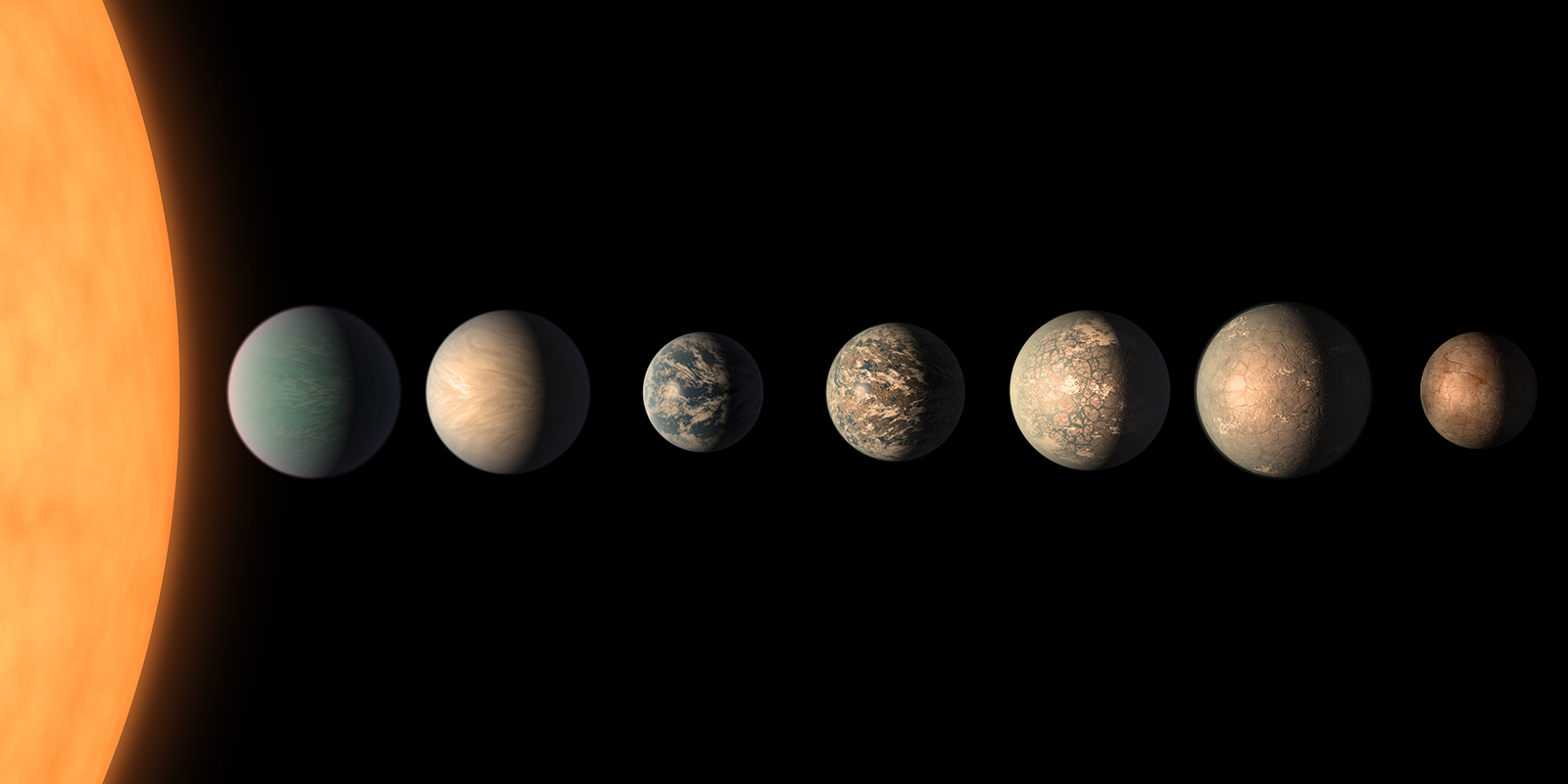
- TRAPPIST-1 System: A system of seven Earth-sized planets, three of which are in the star’s habitable zone. This system is particularly interesting because of the potential for interplanetary habitability. NASA page. Explore the system in 3-D
- Gliese 1214 b: Known as a “water world,” this exoplanet has a thick, steamy atmosphere and is believed to have an ocean or ice layer.
- HD 209458 b (Osiris): This was the first exoplanet discovered that was seen transiting its star. It has a very short orbital period and is known for its extended atmosphere, which is being stripped away by the star.
- Kepler-452b: Sometimes referred to as “Earth’s cousin,” this planet is in the habitable zone of its star and is close in size to Earth, although much older.
- 55 Cancri e: An incredibly hot planet thought to be covered in lava, it orbits its star so closely that a year lasts just 18 hours. NASA page
- J1407b: Known for its enormous ring system, which is much larger and heavier than Saturn’s and may have moons forming within them.
- WASP-12b: A “hot Jupiter” with one of the shortest orbital periods known, it’s also being consumed by its host star, providing valuable insights into planetary dynamics.
- K2-18b: This exoplanet is intriguing because it’s located in the habitable zone of its star and has an atmosphere that contains water vapor, raising questions about its potential for habitability. NASA page.

Stellar Farewell (For Now)
As our interstellar tour of ‘An Exoplanet Round-Up, Part 1’ comes to a close, we hope you’ve enjoyed this astronomical adventure as much as we have. These ten exoplanets are just a small sample of the wonders that lie beyond our solar gaze, each a reminder of the boundless possibilities that our universe holds. As we continue to peer deeper into the cosmos, who knows what other astonishing worlds we’ll discover? Until ‘Part 2’ of our exoplanet exploration, keep looking up and wondering. The universe has endless stories to tell, and we’ve barely scratched the surface!

 Touching the Awesome!
You must be logged in to post a comment.